
Your unclaimed MLC royalties don't wait for you forever, they'll go to publishers with bigger catalogs.
Full catalog scan. Results in 7 days. Find and claim every MLC royalty you're missing.
In early 2027, the MLC will start permanently redistributing unclaimed royalties by market share. Nexus matches your catalog against the full MLC database, finds every ownership gap and missing recording, then files the claims for you. Ensuring your registrations are correct and royalties are paid to you before the 2027 market share distributions begin.
$5,000 for 6 months of full platform access. 20% recovery fee on recovered royalties, invoiced after MLC pays you.
MLC Market Share Distributions Begin Early 2027.
Is your catalog at risk?
- Even well-managed catalogs can have claimable issues on 15-25% of their works. This is caused by new covers, re-releases, and incomplete registrations by other publishers that no team can track by hand.
- Match, prioritize, submit, and track claims every week. Automatically. So your team maximizes your full catalog, not just your top writers.
- It's not too late. There's still time to file and recover your unclaimed royalties before the market share distributions begin.
$638 million in undistributed royalties are sitting at the MLC right now.
Per its 2025 Annual Report, the MLC is holding $161 million in historical royalties from 2007-2020, plus another $477 million in blanket royalties from 2021 onward that it hasn't been able to distribute to rights owners.
These royalties fall into two categories:
- Unmatched Recordings: A recording that has earned royalties but couldn't be linked by the MLC to a registered work. This could be a cover, a re-release, a mistitled track, or possibly a work you never registered.
- Unclaimed Registrations: A registered work that has been linked to 1 or more recordings, but 100% of the registration has not been claimed.
In both cases, the MLC is holding the royalties for you, but you're not getting paid.
Even with a full team of catalog admins, chasing down these gaps by hand is nearly impossible across a full catalog when new issues are constantly being created each week. So publishers focus on fixing registrations for their top writers and songs putting the rest off for another day. That worked when the royalties waited forever, but not anymore.
Give your catalog admin team the power to cover every writer, not just the top ones.
Built for publishers who manage catalogs, not just own them.
Nexus does the research. Your team approves the claims.
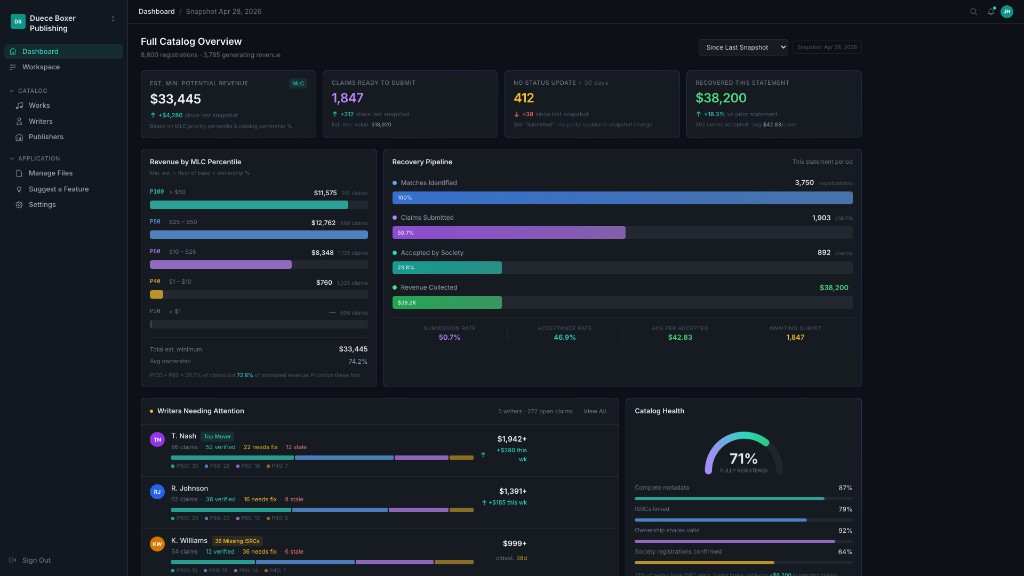
See how your entire catalog is registered at the MLC. In days, not months.
Nexus will ingest your catalog, match your works against the full MLC database, finding every registration that should be tied to your works.
Every match is scored and traceable so that your team can see exactly why it was made.
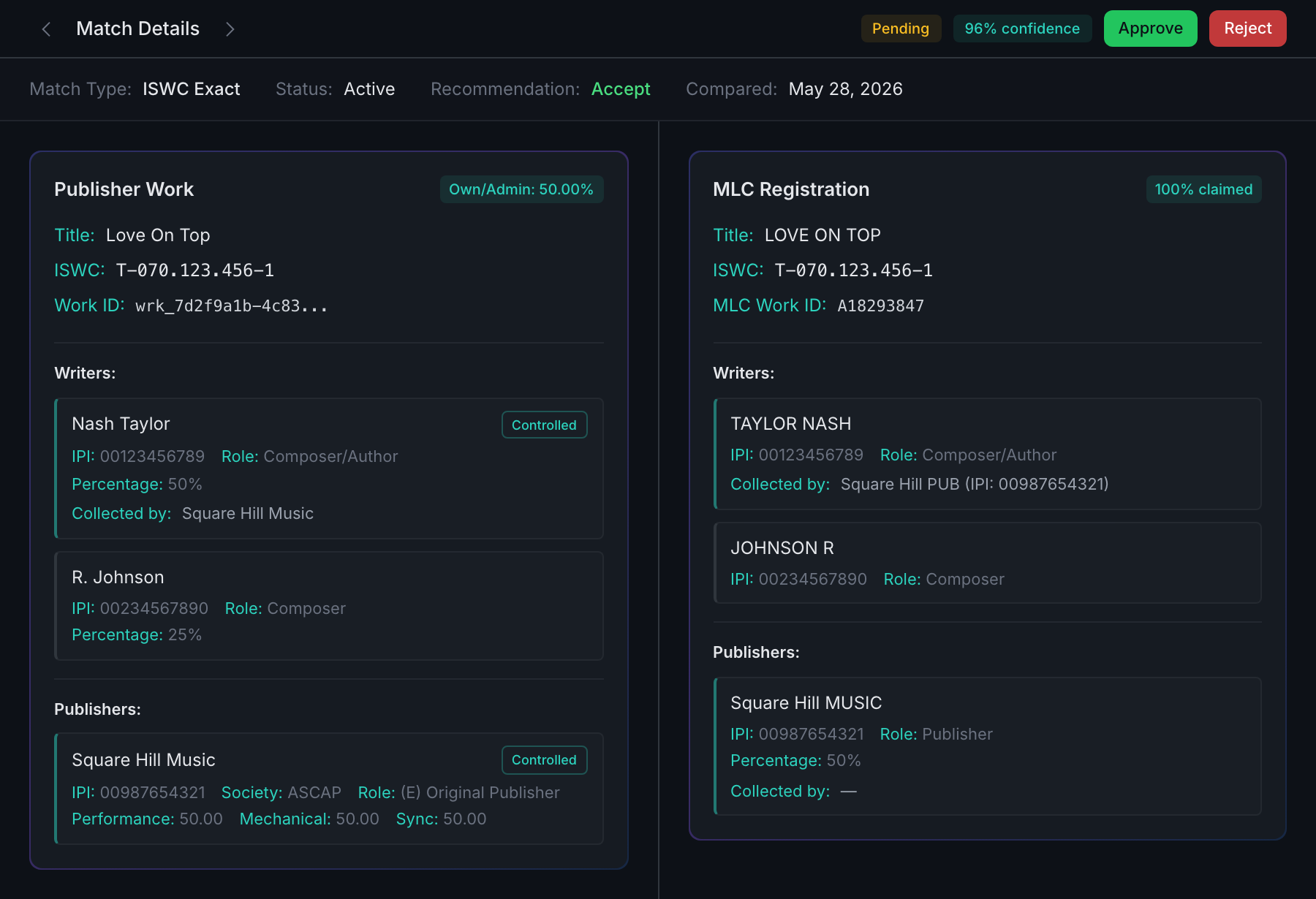
Stop guessing what you're missing
Nexus then analyzes every work / registration match to ensure you're collecting all your royalties. When issues are found, it automatically categorizes them and creates the appropriate claim for you to review.
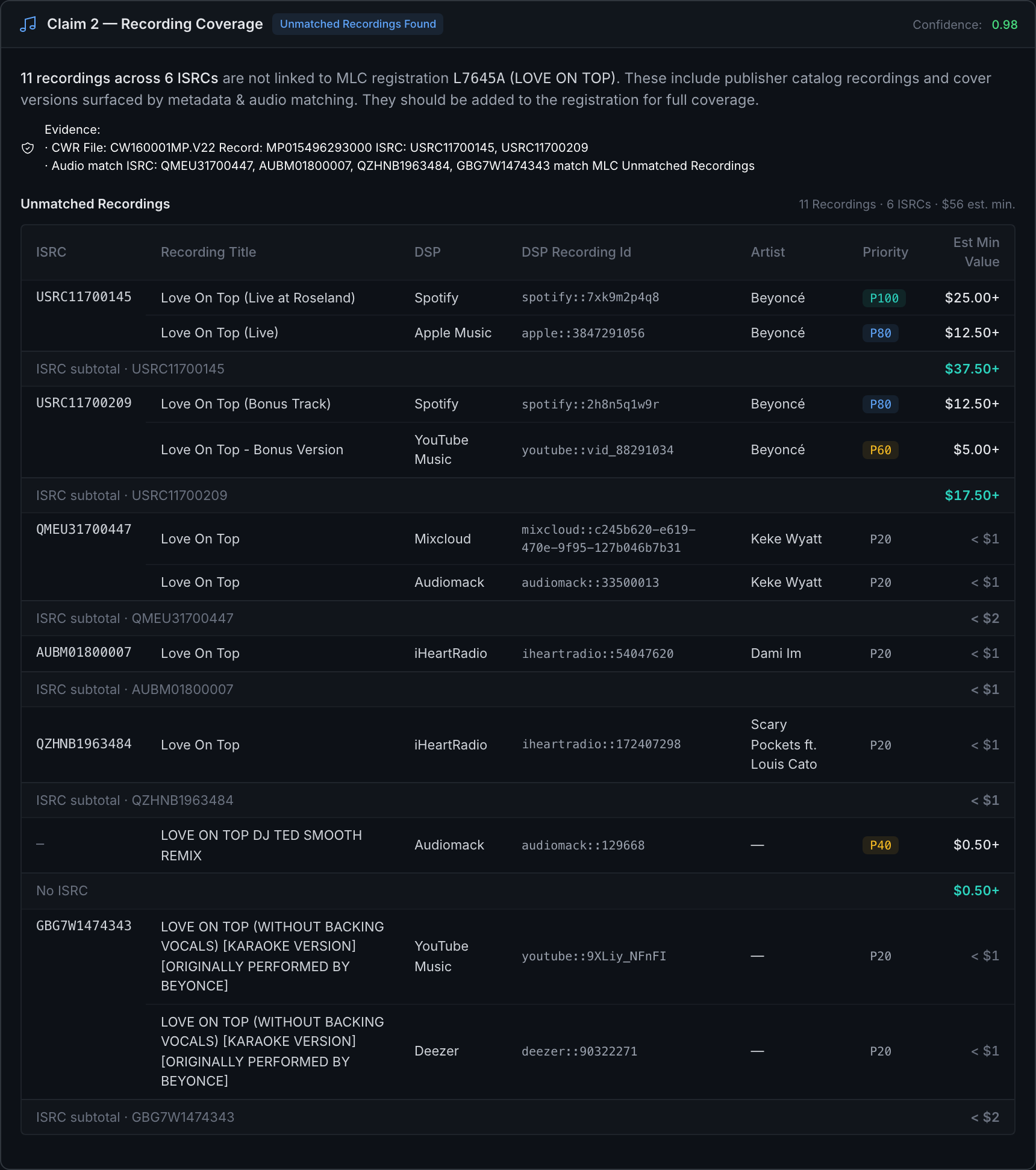
- Unmatched Recordings: ISRCs and recordings not linked to your registration
- Unclaimed Registrations: Your writer and their ownership percentage is not correctly claimed on the registration
- Unregistered Works: Works in your catalog that are not registered at the MLC.
- Metadata Inconsistencies: title, writer name, ISWC and IPI errors
Find hidden royalties without spending hundreds of hours comparing recordings.
Not every royalty gap shows up in registration data. Covers, interpolations, remasters, and re-releases often appear in the MLC's system under different titles with different metadata, making it harder for your team to find using traditional matching techniques.
Nexus listens to the actual audio, comparing your catalog masters against MLC-linked recordings on a per-platform basis — the same way royalties actually flow. That surfaces covers, remasters, and re-releases metadata alone would miss.
Audio comparison is live for a growing set of DSP feeds today, with more platforms added as integrations ship. Recordings on platforms not yet automated are still surfaced through metadata matching and queued for review.
Approve claims in minutes, not days
Findings flow into claim packets, grouped by writer, scored by confidence, and prioritized by potential impact. Your team reviews packets in a purpose-built queue: approve, reject, or edit at the individual claim level.
Clear-cut findings can be batch-approved to move fast. Ambiguous cases are flagged for your team. Every action is audited. Nothing goes to the MLC without your sign-off.
-
Findings detected
Discrepancies auto-categorized from catalog and recording analysis
-
Claim packets built
Grouped by writer, scored by confidence, prioritized by impact
-
Review queue
Your team works through packets in a purpose-built inbox
-
Approve, reject, or edit
Batch clear-cut claims · flag ambiguous cases · full audit trail before MLC submission
Approve. Submit. Get paid.
Approved claims are validated against MLC requirements, batched by writer, and submitted on your behalf.
- No manual data entry.
- No formatting errors.
- No hours spent building claim forms by hand or resubmitting CWRs that you've sent before.
You approve the claims, Nexus uploads it to the MLC portal and tracks its status, you collect the royalties.
-
You approve claims
Nothing moves forward without your sign-off
-
Validate against MLC requirements
Formatting and field checks before anything leaves Nexus
-
Batch by writer
Claims grouped for efficient MLC portal submission
-
Submit to MLC portal
Nexus uploads on your behalf — no manual data entry
-
Track claim status
Monitor submissions until the MLC processes them
-
Collect royalties
Registrations corrected, recordings linked, royalties flow to you
$5,000 and 20% of found money. That's it.
The Market Share Protection Sprint gives you 6 months of full platform access: catalog scanning, claim generation, audio matching, and ongoing monitoring, timed to protect your royalties before the 2027 MLC redistribution.
What You Get
- Full catalog scan against MLC's complete database (55M works, 1.1B recordings)
- Claim packet generation for every discrepancy found
- Audio fingerprint matching for recordings metadata can't find
- MLC-ready TSV export files and claim submission support
- Ongoing delta monitoring as MLC data updates
- Priority claim filing support before the 2027 deadline
- Dashboard, search, review queue, and audit trail
- 6 months of full platform access
What It Costs
$5,000
Upfront · one-time sprint fee for 6 months of full access
20%
Of initial undistributed royalties recovered · invoiced only after MLC pays you. You keep all royalties moving forward. Nothing owed if a claim isn't paid.
After 6 months: continue on an annual plan priced to your catalog. Your sprint fee credits toward Year 1.
The Math
| Your Cost | Your Return | |
|---|---|---|
| Sprint fee | $5,000 | — |
| Recovery fees (20% of ~$200K recovered) | ~$40,000 | — |
| Total cost | ~$45,000 | — |
| Royalties recovered | — | ~$200,000+ |
| Net to you | — | ~$155,000+ |
| Cost of doing nothing | — | $200,000+ permanently redistributed |
Illustrative example only. Actual recovery depends on your catalog size, registration status, claim acceptance, and MLC payout timing. Your results will vary.
You only pay the recovery fee after the MLC pays you.
We don't collect until you collect. If we find discrepancies but the MLC doesn't pay out, you owe nothing on the recovery side. If we find nothing at all, you're out $5K and you have confirmation your catalog is clean.
Our incentive is to find every dollar before the 2027 deadline, not to generate reports.
Catalog scanned and first claims ready for approval all within 7 days. Here's how.
Share Your Catalog
Send us your catalog. We ingest your CWR files and run the initial match against MLC's full database. Your account is set up and your data is isolated. No one else sees your catalog.
Review Your Findings
Within 7 days, you see every discrepancy: missing recordings, unclaimed registrations, missing registrations, and metadata errors. Each finding is prioritized by estimated recovery value and deadline exposure, so you know what to file first.
Collect Your Royalties
We generate claim packets for every discrepancy found. You review and approve them in a purpose-built queue. Approved claims are then submitted to the MLC on your behalf. We monitor the status of the claims and you collect your royalties as they're approved.
We're taking a limited number of publishers through the Market Share Protection Sprint before the 2027 deadline.
- Must have MLC membership and administer your catalog there
- Minimum catalog size of 10 controlled writers
Slots are allocated based on catalog size and readiness. Apply now. Onboarding starts within days of approval.
Got questions? We're here to help.
What are MLC market share distributions?
Starting in early 2027, the MLC will permanently redistribute unclaimed royalties to publishers based on their relative market share. This is mandated by the Music Modernization Act. Any royalties that remain unmatched or unclaimed when the distribution occurs will be allocated pro rata, meaning publishers with larger market share receive proportionally more. Once redistributed, those royalties cannot be reclaimed by the original rightsholder. The MLC has held these royalties for six years (twice the statutory minimum), and distributions will start with 2021 usage and work forward.
What happens if I don't file claims before the 2027 deadline?
Royalties from 2021 usage will be the first redistributed, with subsequent years following. If your works have unmatched recordings, unclaimed shares, or ownership discrepancies that aren't corrected before the distribution occurs, the associated royalties will be permanently redistributed to other publishers based on market share. After the blanket royalties, the MLC will process the remaining historical royalties from 2007-2020. Nexus identifies these discrepancies and generates the claim packets needed to file before each deadline.
What's included in the Market Share Protection Sprint?
The Sprint is a 6-month engagement ($5,000 upfront) that includes full catalog scanning against MLC's database, claim packet generation for all discrepancies found, audio fingerprint matching, submission of MLC-ready claim files, ongoing monitoring, and a review queue. On top of the sprint fee, we charge a 20% recovery fee on the initial undistributed royalties we help recover, invoiced only after the MLC has paid you. After 6 months, continue on an annual plan priced to your catalog. Your sprint fee credits toward Year 1 if you choose to continue.
How is Nexus different from ClaimAssist?
ClaimAssist was a managed service: you shared your catalog and we delivered claim forms for upload. Nexus is the platform that powers it. With Nexus, you get direct access to the matching engine, the discrepancy findings, the review queue, the audio matching pipeline, and the export tools. You see everything. You control the workflow. And with the Market Share Protection Sprint, you get 6 months of full access timed to protect your catalog before the 2027 MLC redistribution.
Do I keep 100% of my royalties?
We never take a percentage of your regular royalty distributions. Those are 100% yours. On top of the sprint fee, we charge a 20% recovery fee on undistributed royalties that Nexus helps you find and claim. This is money you weren't collecting before: new revenue we helped surface. Once your registrations are corrected and the MLC is paying you correctly, the ongoing distributions are yours.
What catalog formats do you accept?
CWR is preferred. We also accept TSV, CSV, Excel, Google Sheets, and PDF. If you have catalog data, we can ingest it.
How does matching work?
Nexus matches your catalog to MLC registrations using multiple methods, starting with exact identifier matching (IPI, ISWC, ISRC) and progressing to more sophisticated techniques for works where exact IDs aren't available. Audio fingerprinting catches recordings metadata alone can't find. Every match is scored with a confidence level and linked to the evidence that produced it, so your team can see exactly why a match was made.
Is my data secure?
Absolutely. Every publisher gets their own completely isolated account. Your catalog, findings, and claims are never visible to anyone else on the platform. Your workspace is private by design, and we enforce that separation at every level of the system, not just the login screen.
Can Nexus submit claims directly to the MLC?
Yes. After you review and approve claims in Nexus, we validate them against MLC requirements and submit them on your behalf. You stay in control of what gets filed. Nothing goes to the MLC without your sign-off.
How much money could I be leaving on the table?
We can't give you a specific dollar amount before running the analysis. To prevent fraud, the MLC doesn't publish undistributed royalty amounts tied to individual registrations. But we can tell you how many registration gaps, ownership discrepancies, and unclaimed recordings exist in your catalog after the initial match. For most publishers, the number is higher than they expect.
We've analyzed hundreds of catalogs against MLC data. Here's what we learned.
Before Nexus, we built MLC ClaimAssist, a service that helped publishers recover undistributed royalties by matching their catalogs against MLC registrations. We've analyzed hundreds of publisher catalogs against MLC data, and every single one had gaps: missing recordings, unclaimed registrations, ownership mismatches, share discrepancies. Not some of them. All of them.
Every single one had gaps.
That experience taught us two things. First, this problem is universal: it doesn't matter how big or small your catalog is, there are royalties you're not collecting. Second, publishers don't just want someone to find the money. They want to see it for themselves, and they want the tools to act on it.
Every matching method, every discrepancy type, every export format in Nexus was shaped by what we found in those catalogs. The difference is that now you don't have to wait for us to run it. You run it yourself, whenever you want.
Stop researching. Start recovering. See what you're missing in days.
Questions? Email [email protected] or book a call.